
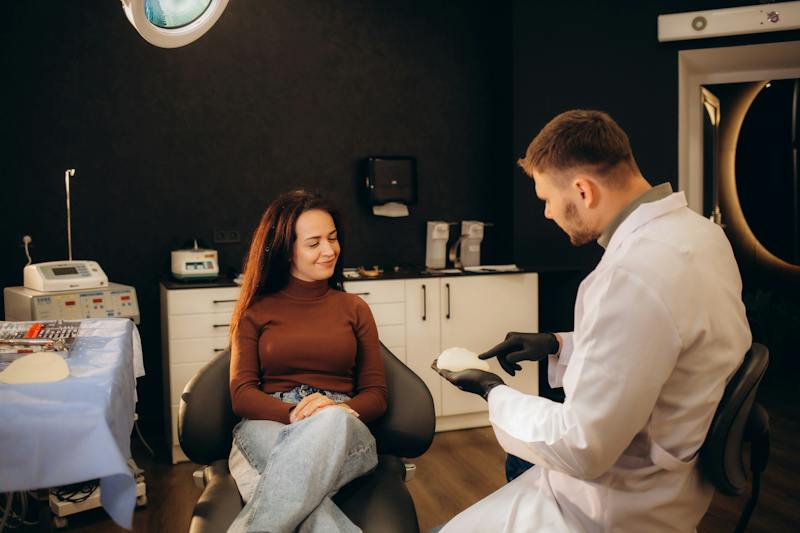
Silicone and saline implants can both create beautiful breast augmentation results. The right one depends on your body, age, and priorities. Silicone implants feel softer and more natural for many patients, and they’re FDA-approved for cosmetic augmentation at age 22 and older. Saline implants are approved at age 18 and older. They cost less, can be placed through smaller incisions, and make a rupture easy to notice. Silicone implants call for periodic imaging to check for leaks. The best way to choose is to talk with a board-certified plastic surgeon who can examine your tissue and talk through your goals.
At Florida Plastic Surgery Group, implant type is one of more than ten variables our surgeons customize during breast augmentation in Jacksonville. The others include size, profile, placement, and incision. This guide explains how silicone and saline compare, so you can come to your consultation ready to make a confident choice.
What is the difference between silicone and saline implants?
The difference between silicone and saline implants is what fills them. Both have a silicone outer shell. Saline implants are filled with sterile salt water, and silicone implants are filled with silicone gel. The FDA has approved both types for breast augmentation, and each offers distinct advantages depending on your anatomy and goals.
According to the FDA, some saline implants come pre-filled. Others are filled during surgery, which is why saline implants can go in through a smaller opening. Silicone gel implants arrive pre-filled and hold their shape. They come in different degrees of cohesiveness, sometimes called "gummy bear" implants.
Florida Plastic Surgery Group uses smooth, round implants in both silicone and saline. Your surgeon will also help you choose a profile (how far the implant projects from your chest) that matches your chest width. You can explore every option on our breast implant options page.
Silicone vs saline at a glance
Silicone and saline implants differ in feel, minimum age, incision size, rupture detection, follow-up imaging, and cost. Silicone generally offers a softer, more natural feel, especially for patients with thin tissue. Saline offers a lower implant cost, a smaller incision, and easy rupture detection. The table below compares the two side by side.
| Feature | Silicone implants | Saline implants |
|---|---|---|
| Fill | Silicone gel | Sterile salt water (saline) |
| Feel | Softer, more natural feel | Firmer; not as soft or natural feeling |
| Rippling | Less rippling | Can show visible rippling, especially with thin tissue |
| Minimum age (cosmetic augmentation) | 22+ (FDA) | 18+ (FDA) |
| Incision size | Larger | Smaller; can be placed through the armpit or belly button |
| Rupture detection | Often "silent"; found with imaging | Easy to notice; the implant visibly deflates |
| Recommended imaging | MRI or ultrasound 5–6 years after surgery, then every 2–3 years (ASPS) | Deflation is usually visible, so detection doesn’t depend on screening imaging |
| Relative implant cost | Higher | Lower |
Who is a good candidate for silicone implants?
Silicone implants are often a great fit if you’re 22 or older and want the softest, most natural-feeling result. They tend to look smoother in patients with thin skin or little natural breast tissue, because silicone gel ripples less. They also suit patients who are comfortable with periodic imaging over the years.
Silicone implants may be a good match if you:
- Are age 22 or older, which is the FDA’s minimum age for silicone augmentation
- Have a slim frame, thin skin, or small natural breasts
- Want a natural feel and a smooth contour
- Plan to keep up with recommended MRI or ultrasound screening
Florida Plastic Surgery Group also offers Motiva® implants, a newer silicone-gel option filled with ProgressiveGel®. Motiva implants are designed to move with your body and may allow a smaller incision. You can see real patient outcomes in our silicone breast augmentation gallery (contains nudity, 18+).
Who is a good candidate for saline implants?
Saline implants are often a great fit if you’re between 18 and 21, want a lower implant cost, or prefer the smallest, most hidden incision. A saline implant can be placed empty and filled in place. That means it can go in through the armpit or belly button, leaving no scar on the breast itself.
Saline implants may be a good match if you:
- Are 18 or older and under 22, since saline is FDA-approved for augmentation at 18+
- Want to keep implant costs lower
- Want a well-hidden incision in the armpit or around the belly button
- Like knowing right away if an implant has a problem
Patients with enough natural breast tissue to cover the implant often get very natural-looking results with saline. Browse our saline breast augmentation gallery (contains nudity, 18+) to see examples.
How does each implant look and feel?
Silicone implants generally feel softer and closer to natural breast tissue than saline implants. Saline implants feel firmer and are more likely to show rippling, which means small visible folds or waves under the skin. Your own tissue thickness and where the implant sits matter as much as the fill.
A prospective 3-year study of 223 women with implants placed under the chest muscle found similar rippling rates for saline and silicone (Swanson, PRS Global Open, 2020). Ultrasound detected folds in 10% of saline patients and 7% of silicone patients. The study also found more rippling in patients with a lower body mass index (BMI). This is why surgical planning matters so much for slimmer patients.
At Florida Plastic Surgery Group, surgeons often use a dual-plane technique, which places the implant partly under the muscle. The extra tissue coverage helps soften the edges of either implant type. The amount of muscle coverage is tailored to each patient’s anatomy for a smooth, natural look.
What happens if a silicone or saline implant ruptures?
A ruptured saline implant deflates within a short time. The breast looks visibly smaller, and the body safely absorbs the salt water. A ruptured silicone implant is often "silent," which means you may not see or feel any change. That’s why the FDA recommends routine imaging for silicone implants to catch a rupture early.
According to the FDA, most silicone ruptures cause no symptoms. When silicone does leak, the gel usually stays contained within the natural scar tissue around the implant. MRI is the most effective way to detect a silent rupture, and ultrasound is an acceptable alternative for patients without symptoms. The current recommendation is screening 5–6 years after silicone implant surgery, then every 2–3 years (ASPS).
The FDA also notes that breast implants are not lifetime devices, so either type may eventually need to be replaced (FDA). Your surgeon will review the FDA’s patient decision checklist with you, including possible complications such as capsular contracture (scar tissue tightening around the implant). One more note on implant surface: the FDA reports that BIA-ALCL, a rare lymphoma linked to breast implants, appears more often with textured implants (FDA).
How much do silicone and saline implants cost in Jacksonville?
At Florida Plastic Surgery Group, the average range for breast augmentation is about $5,999–$8,999+. The national all-in average is often cited at $8,000–$12,000. Silicone implants themselves cost more than saline implants. Your exact price depends on your implant choice, surgical plan, and any combined procedures.
The total cost of breast augmentation covers more than the implant. It also includes the surgeon’s fee, the operating facility, and anesthesia. After your consultation, our team will give you a clear, transparent estimate. When budgeting for silicone, also plan for future MRI or ultrasound screening, which may not be covered by insurance (FDA).
You can review our plastic surgery pricing and explore flexible financing options to find a plan that fits your budget.
How do you choose the right implant at your consultation?
You choose the right implant by working through your goals, anatomy, and lifestyle with a board-certified plastic surgeon. At Florida Plastic Surgery Group, surgeons assess more than ten variables for every augmentation. These include implant fill, size, profile, placement, and incision, so your result is built around your body rather than a one-size-fits-all approach.
During your consultation, your surgeon will:
- Measure your chest and evaluate your skin and tissue thickness
- Listen to your size and shape goals
- Explain which incision options work with silicone or saline
- Talk through Motiva® and other implant options
- Review the FDA patient decision checklist with you
If you also have sagging, a breast lift with implants can restore both lift and volume. Patients who prefer an implant-free option can ask about fat transfer breast augmentation, which gives a more subtle increase in size. If you’re traveling or want to start from home, you can book a virtual consultation.
FAQs
Can I switch from saline to silicone implants later?
Yes, you can switch from saline to silicone implants later through a revision surgery. Many patients make this change once they reach age 22 or decide they want a softer feel. Your surgeon will evaluate your existing implants and tissue to plan the exchange. You can learn more on our breast augmentation revision page.
Do silicone or saline implants last longer?
Neither silicone nor saline implants are designed to last a lifetime. The FDA notes that the longer you have implants, the more likely you are to need them removed or replaced. Plan for possible future surgery with either type. Your surgeon will explain what to watch for and how follow-up care keeps your results looking their best over time.
Which implant type is better for a thin or athletic frame?
Silicone implants are often preferred for a thin or athletic frame because silicone ripples less and feels softer under thin tissue. Research has linked a lower body mass index (BMI) to more visible rippling. Placing the implant partly under the muscle adds coverage for either type. Your surgeon will recommend the best combination for your body during a consultation.
Will my implant type affect breastfeeding or mammograms?
Breast implants of either type are not expected to stop you from becoming pregnant or breastfeeding. However, pregnancy can change how your results look over time, so some patients wait to have surgery. For mammograms, always tell your imaging team you have implants so they can adjust their technique. Your surgeon can answer questions about your specific plans.
Are Motiva implants silicone or saline?
Motiva® implants are silicone gel implants. They’re filled with a gel called ProgressiveGel®, which is designed to adapt to your body’s movement for a natural look and feel. Motiva implants may also allow a smaller incision. Florida Plastic Surgery Group offers Motiva implants, and your surgeon can help you decide whether they suit your goals.
Is the recovery different for silicone vs saline implants?
Recovery is generally similar for silicone and saline implants. Most patients return to normal activities in about a week. Avoid vigorous cardio for two weeks and upper-body exercise for the first month. Florida Plastic Surgery Group offers a narcotic-free enhanced recovery protocol (ERAS) and 24/7 access to providers to help keep your healing comfortable and smooth.
Find Your Ideal Implant in Jacksonville
Silicone and saline implants both offer beautiful, natural-looking results when matched to the right patient. The best choice depends on your age, anatomy, budget, and goals. A board-certified plastic surgeon can help you weigh these with confidence. To start planning your breast augmentation with Florida Plastic Surgery Group, schedule a consultation at our Riverside, Southside, Jacksonville Beaches, or Fleming Island location. You can also call (904) 922-4009.